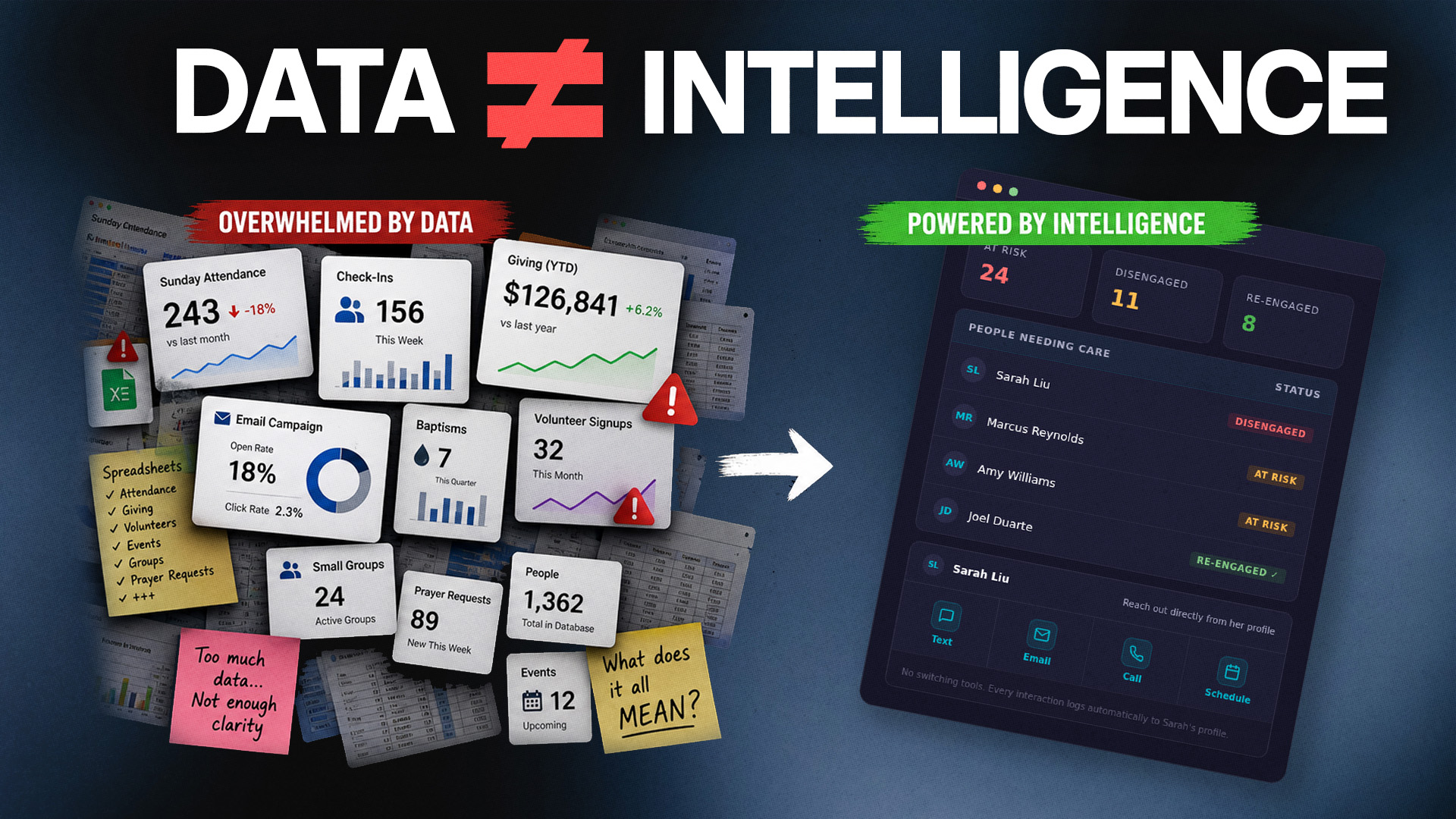
Most churches don't have a data problem. They have too much data.
It lives in Planning Center. In PushPay. In Mailchimp, in Brushfire, in your kids check-in system, and in a dozen other platforms your team logs into every week. Attendance here. Giving there. Serving records somewhere else. Every one of those tools is doing its job. Every one of them holds a piece of the story.
The problem is that none of them talk to each other. And raw data without connection is just noise.
If you have already invested in good tools, you made the right call. The instinct to measure, to track, to see your church clearly is a pastoral instinct, not a technical one. But there is a next step most churches never take, and it is the whole difference between knowing what happened and knowing what to do about it.
Data Is What Happened. Intelligence Is What It Means.
Here is the distinction that changes everything.
Data is a record. It tells you that attendance dropped, that a gift stopped, that a volunteer shift went unfilled. Intelligence is interpretation. It tells you what those things mean together, and what a specific person needs next.
A church can have perfect attendance records, complete giving histories, and detailed volunteer logs, and still have no idea that a four-year member is three weeks from walking out the back door. Not because the signals weren't captured. Because no one connected them.
You have the data. What you don't have is intelligence.
The Three Stages of Church Data Maturity
Most churches are somewhere on this path. There is no wrong place to be. The goal is simply to know where you are and what comes next.
Stage 1: Data Storage. Information lives inside individual systems. Your ChMS holds attendance. Your giving platform holds donations. When you need to know something, someone pulls a report by hand. The data exists, but seeing it takes effort, and the picture is always a few days old.
Stage 2: Data Visibility. Dashboards enter the picture. Trends become visible. You can see that giving dipped last quarter, or that small group attendance is softening. This is real progress. But it is still reactive. The dashboard shows you a trend after it has already formed, and it still leaves the interpreting, and the acting, to you.
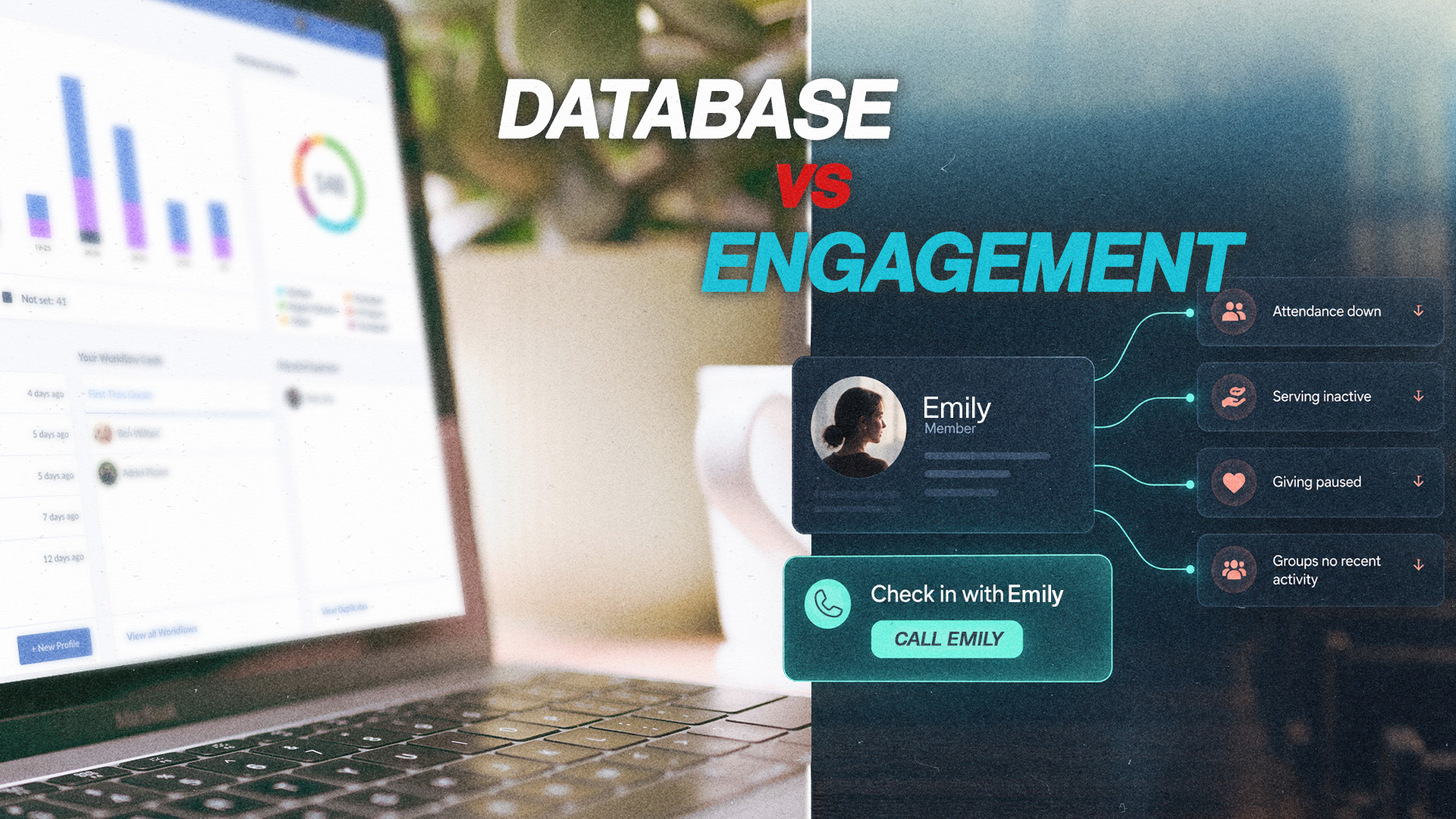
Stage 3: Pastoral Intelligence. Data from every system connects into one unified picture of each person. Patterns surface on their own. When someone's engagement shifts across attendance, giving, groups, and communication at the same time, the system notices, and the right team member gets a notification at the right moment. Follow-up gets assigned. Outcomes get tracked. You find out someone is drifting while you can still do something about it.
Most churches invest heavily to get from Stage 1 to Stage 2, and then plateau. Stage 2 feels like the finish line. It isn't. It's the halfway point.
Why AI Alone Won't Get You to Stage 3
It is fair to ask whether AI closes this gap on its own. It doesn't, and it helps to understand why.
AI can accelerate Stages 1 and 2 dramatically. It can clean data, summarize trends, and surface correlations faster than any staff member pulling reports by hand. That is genuinely useful, and it is worth having.
But Stage 3 is a different kind of work. Telling you that a specific person needs a text from a specific team member on Tuesday morning is not a data task. It requires human judgment, pastoral instinct, and a system deliberately built to prompt action, not just produce insight.
The technology connects the dots and raises its hand. A person still does the shepherding. Intelligence, in the sense that actually matters to a church, is the two working together.
This Is What the Shepherding Gap Actually Is
Picture a member. Four years in. Faithful. Then things quietly shift.
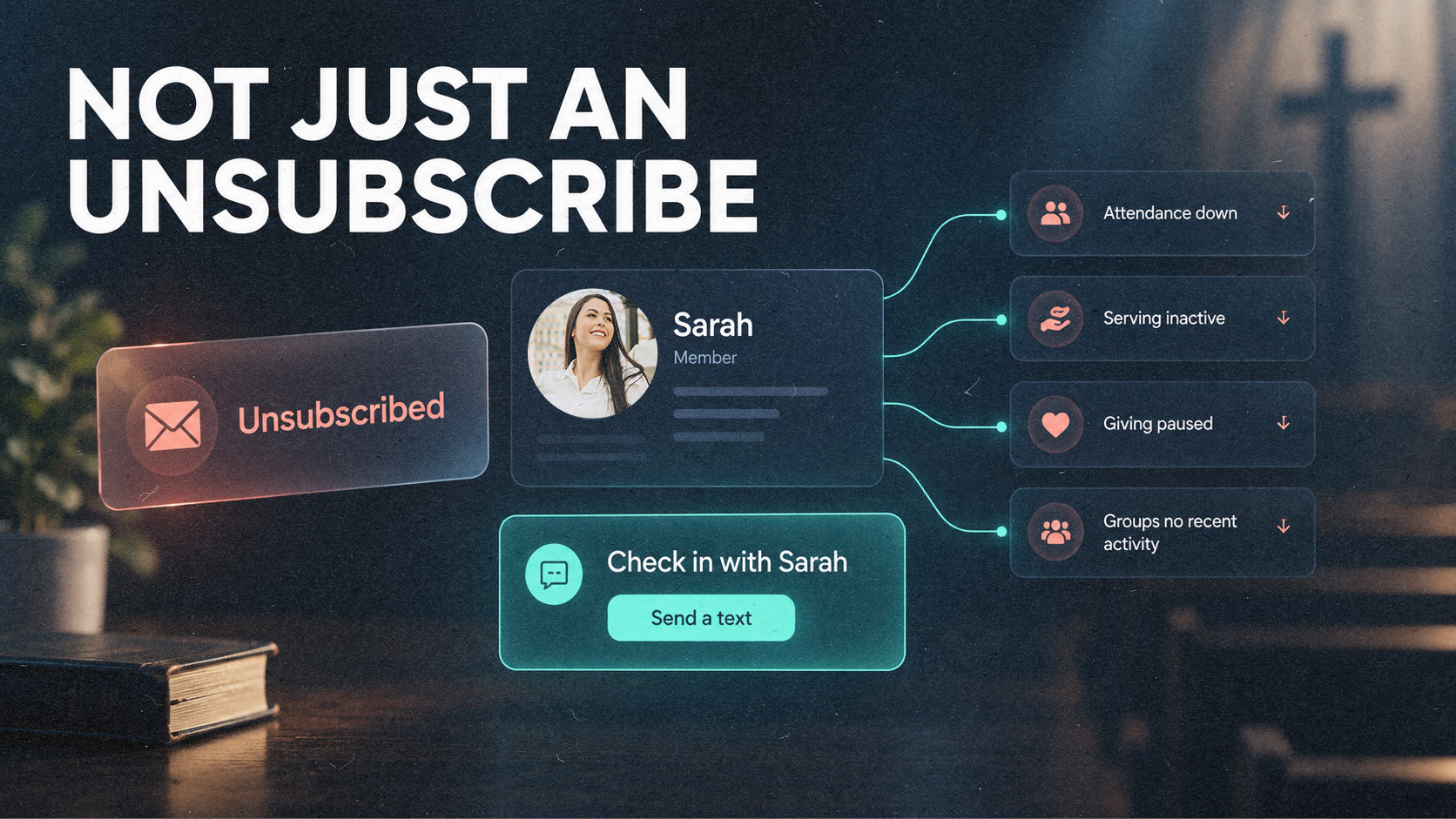
His attendance drops from weekly to twice a month. He cancels two serving shifts. He misses small group three times in a row. He stops opening emails. Eventually, his recurring gift cancels.
Every one of those signals was captured. Attendance in one system. Serving in another. Small group in a third. Communication somewhere else. Giving somewhere else again. The data was all there.
But no one saw it connected. The attendance tool didn't know about the giving. The group leader couldn't see the serving. And so a person your church loved drifted for months before anyone realized he was gone.
That distance, between when someone starts drifting and when your team actually notices, is the Shepherding Gap. And notice what it is not. It is not a data gap. Every signal existed. The gap was that no one saw them as one picture, tied to one name, in time to act.
Closing that gap doesn't require more data. It requires intelligence: a unified view, early detection, and a clear next step for a real person.
What Church Intelligence Looks Like in Practice
It is easy to hear the word "intelligence" and imagine more dashboards and better reports. It is closer to the opposite.
In practice, it looks like this. A team member's phone buzzes. The notification tells them exactly who to reach out to and why. They can see the whole picture at a glance: this person has slipped across several areas at once. They send a text or an email right there, without switching tools. They log the conversation. Later, everyone can see whether that person re-engaged.
That is the shift. Not more information for leaders to sort through. One clear next step, for one person, handed to the right team member at the moment it matters. Most systems stop at insight. The real work of a church is everything that happens after.
Because in the end these were never metrics. They are names.
People don't need to be managed. They need to be known.
Frequently Asked Questions
What is church data analytics? Church data analytics is the practice of collecting and interpreting information about congregational engagement: attendance, giving, serving, group participation, and communication. Most churches already generate this data across several platforms. The value comes not from collecting more of it, but from connecting it into a single picture that shows who needs pastoral attention, and when.
How do churches use member data? Churches use member data to understand engagement, coordinate follow-up, and care for people intentionally as they grow. Used well, it helps a team notice when someone is drifting early, assign the right person to reach out, and confirm that the person actually
re-engaged, rather than discovering months later that a family quietly left.
What is the difference between a church database and a Relational Engagement System? A church database, or ChMS, is built to store and organize information: records, transactions, schedules, and reports. It is the filing cabinet. A Relational Engagement System sits on top of the tools a church already uses, connects the data between them, detects meaningful changes in each person's engagement, and prompts a specific team member to take a specific action. The database tells you what happened. The Relational Engagement System tells you what it means and what to do about it.
How do you turn church data into pastoral action? You connect the data from every system into one view of each person, let patterns surface automatically, route the right follow-up to the right team member with a clear next step, and track whether the person re-engaged. The point is to move from reports that require interpretation to a single, clear action assigned to a real human being.
What church metrics actually matter? The metrics that matter most are the ones that reveal a change in a person's engagement over time, especially across several areas at once. A single missed Sunday means little. Attendance softening while giving stops and serving lapses is a pattern worth a conversation. And the most important metric is not activity but outcome: did the person come back, and are they engaged and growing again?
See Every Name
You already invested in seeing your church clearly. This is the next step: turning what you can measure into care that actually reaches people, so no one in your church is invisible.