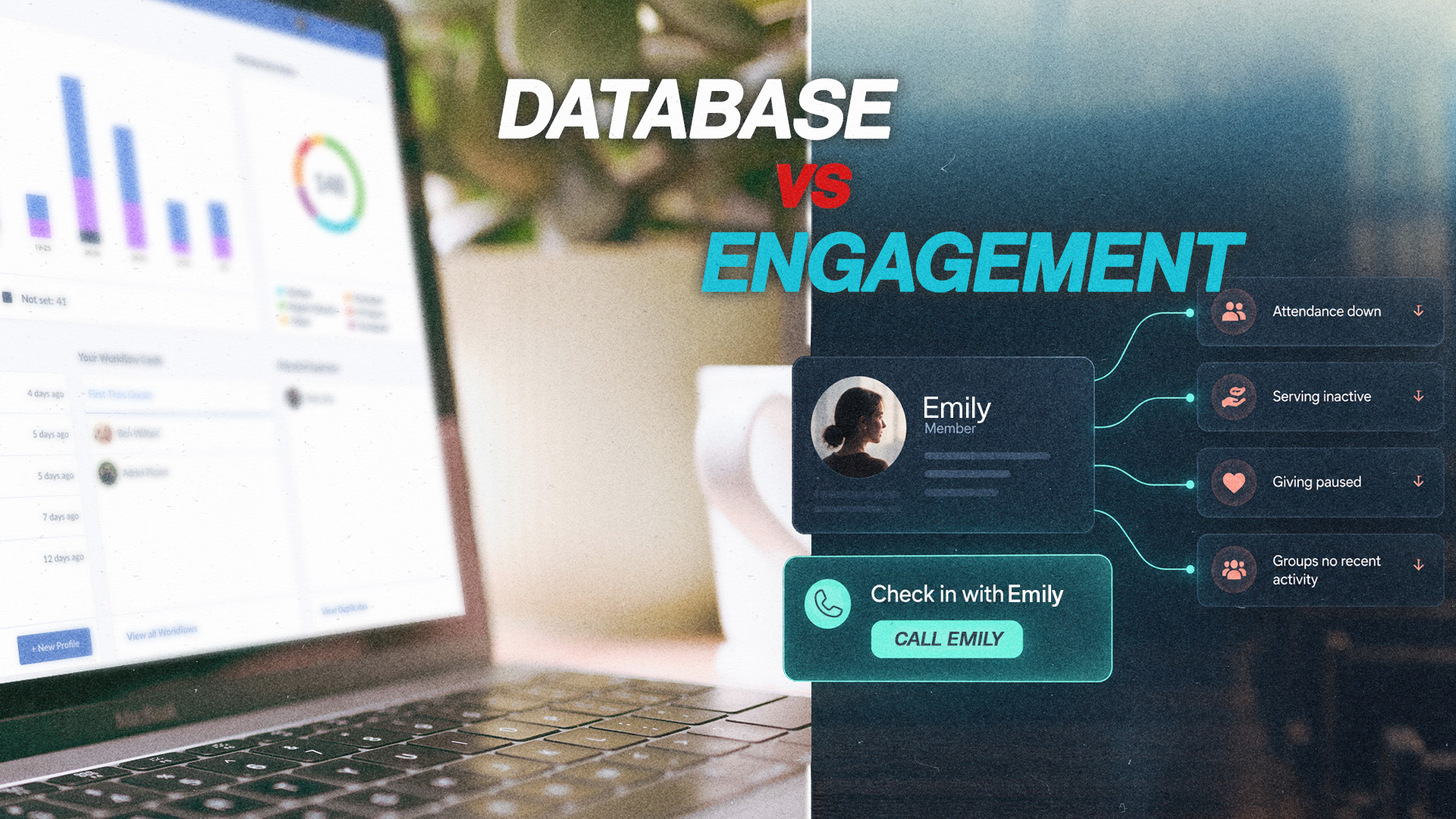

Engagement Analytics for Ministries: What to Track and Why It Matters
Churches do not struggle with a lack of data.
They struggle with knowing what matters.
Attendance is tracked. Giving is recorded. Volunteers are scheduled. Emails are sent. But none of that automatically tells you who is drifting, who needs care, or who feels unseen.
That is where engagement analytics comes in.
Not to manage people.
But to pastor them well.
What Are Engagement Analytics in Ministry?
Engagement analytics are the patterns that reveal how connected someone truly is to your church.
Not just whether they showed up last Sunday.
But whether their overall involvement is growing, steady, or quietly declining.
Healthy churches look beyond isolated data points. They look for patterns over time.
Because disengagement rarely happens overnight.
As we explored in our engagement intelligence articles , most people drift gradually. The shift shows up in small signals long before someone officially leaves.
If you can detect those signals early, you can respond early.
And that changes everything.
Why Tracking Engagement Matters More Than Ever
Ministry has become more complex.
Your church likely uses:
- A ChMS for attendance
- A giving platform for donations
- A communication tool for email and text
- A volunteer scheduler
- A small group system
Each tool does its job well.
But none of them tells you the full story.
Without a unified view, it becomes easy for someone to slowly disengage while no one notices.
And by the time you realize they are gone, the relationship may already feel distant.
Engagement analytics help you answer three critical questions:
- Who needs attention right now?
- What has changed in their engagement?
- What should we do about it?
That is the difference between reactive ministry and proactive care.
The 3 Core Categories of Church Engagement
Before we get into specific signals, it helps to understand the three main dimensions of engagement.
1. Presence
Are they showing up consistently?
This includes:
- Weekend attendance
- Event participation
- Small group involvement
Consistency matters more than raw numbers. A steady decline is more important than a single absence.
2. Participation
Are they contributing and investing?
This includes:
- Serving
- Volunteering
- Leadership roles
- Initiative
When participation decreases, belonging often weakens.
3. Investment
Are they personally committed?
This includes:
- Giving patterns
- Discipleship engagement
- Communication responsiveness
When investment drops across multiple areas, it often signals deeper drift.
The 10 Signals That Reveal Real Engagement
In this series, we will unpack these fully. But here is the high-level view of what churches should track:
- Attendance frequency trends
- Serving consistency
- Small group participation
- Giving patterns
- Communication engagement
- Volunteer initiative
- Relational connection depth
- Discipleship pathway involvement
- Response during life events
- Multi-area pattern changes
The most important signal is not a single metric.
It is change across multiple areas.
When attendance drops and serving stops and giving declines, you are not seeing coincidence. You are seeing drift.
And drift is easier to address early than late.
What Engagement Analytics Are Not
It is important to say this clearly. Engagement analytics are not about monitoring people. They are about noticing people. There is a difference between surveillance and shepherding. Surveillance asks, “Why are they not performing?” Shepherding asks, “How are they really doing?”
The goal is not to control behavior. The goal is to create timely, meaningful connection.
Why Most Churches Miss Early Warning Signs
Most pastors are deeply relational. They care. They remember faces. They notice absence. But growth changes the equation. When your church reaches a certain size, manual noticing breaks down. And as we shared in our engagement and disengagement analysis , data sitting in disconnected systems does not create insight. It creates blind spots.
Attendance might decline in one system. Giving might stop in another. Communication might go unopened somewhere else. Without engagement intelligence, no one connects the dots.
The result?
People drift quietly.
The Real Outcome: Stronger Pastoral Care
When you track engagement intentionally, something powerful happens.
Your team gains clarity.
Instead of reacting to crisis, you:
- Spot decline early
- Reach out quickly
- Start conversations sooner
- Support people through struggle
Often, a simple text in week two prevents a departure in month six.
That is the power of engagement analytics.
It turns data into discipleship.
A Shift From Information to Intelligence
Most churches already have the information.
What they need is interpretation.
Engagement analytics move you from:
Recording attendance → Noticing patterns
Tracking giving → Identifying change
Sending emails → Measuring connection
Managing volunteers → Monitoring ownership
It is the shift from storage to insight.
And insight fuels care.
Here’s Your Next Step
Start simple.
Choose three engagement areas to monitor this month:
- Attendance trends
- Serving consistency
- Small group participation
Look for change, not perfection.
When you see a meaningful shift, reach out with care.
“We have missed you. How are you doing?”
That single sentence can prevent someone from feeling invisible.
And that is what ministry is about.
In the next article, we will go deeper into the 10 signals of real church engagement and the early indicators of spiritual drift.
Because people do not leave suddenly.
They drift.
And faithful shepherds notice the drift early