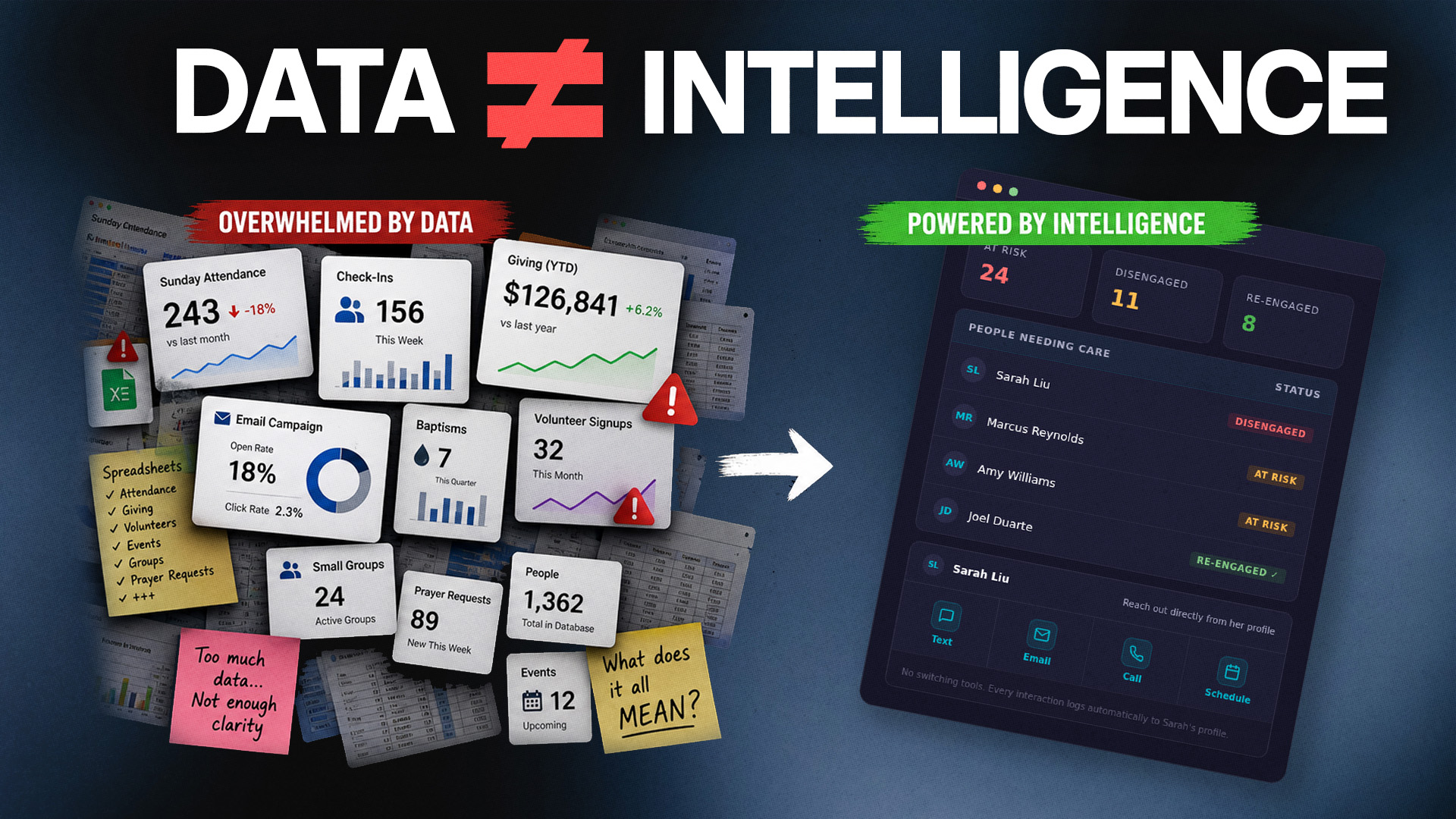

Every pastor has felt the pull by now. AI is showing up in sermon prep tools, communication platforms, volunteer schedulers, and giving analytics. And the promise is compelling: better insights, less admin, more time for ministry.
That promise isn't empty. AI is doing real, meaningful work inside churches right now, and if you haven't started exploring it, you probably should.
But here's what we've noticed after years of working alongside church leaders across the country: the conversation about AI in ministry almost always starts in the wrong place. It starts with what the technology can do. It rarely starts with what your people actually need.
This isn't a critique of AI. It's a pastoral reflection on where it fits and where it doesn't.
What AI Does Well in a Church Context
Let's give credit where it's due. AI is genuinely helpful for churches in several areas.
Pattern recognition across large datasets. If your church has thousands of members spread across multiple campuses, AI can identify attendance trends, giving shifts, and engagement patterns faster than any human team. It can process years of data in seconds and surface things that would take your staff weeks to uncover manually.
Administrative efficiency. From drafting initial communication copy to organizing volunteer schedules to summarizing meeting notes, AI saves real hours. For church staff already stretched thin, those hours matter.
Data synthesis. Most churches use between four and eight disconnected platforms. AI tools can help pull signals from across those systems and organize them into something usable. That's valuable work.
Content creation support. Social media posts, email drafts, sermon research — AI can accelerate all of it. Not replace it. But accelerate it.
If your church isn't exploring how AI can reduce the administrative burden on your team, you're leaving real capacity on the table. The question isn't whether AI belongs in church operations. It does.
The question is whether AI belongs in pastoral care.
Where AI Hits the Ceiling
Here's where the conversation needs to slow down.
AI can tell you that giving is down 12% among members who joined in the last two years. It can flag that weekend attendance has declined three consecutive months. It can even identify which demographic segments are most at risk of disengagement based on historical patterns.
What AI cannot do is tell you that Marcus Reynolds just lost his job last Tuesday. It can't tell you that the Williams family is quietly grieving a miscarriage they haven't shared publicly. It doesn't know that the reason Sarah hasn't been at small group is because she and her husband are struggling and she's embarrassed to show up.
Data has no pastoral instinct.
AI can analyze behavior. It cannot discern the human story behind the behavior. And in ministry, the story is everything. The story is where care begins.
A pastor who calls Marcus after seeing a giving decline in an AI report is doing something good. But a pastor who calls Marcus because a team member noticed, was assigned to follow up, reached out, and discovered what was really going on — that's shepherding.
One is informed by data. The other is driven by relationship.
Both matter. But they are not the same thing.
AI can help you do metrics better. Nurture helps you do ministry better.
This Is a Shepherding Problem, Not a Data Problem
We talk a lot about something called the Shepherding Gap — the space between when someone starts drifting and when someone on your team actually notices.
Most church leaders assume the gap exists because they don't have enough information. But that's rarely true. The information is almost always there. Attendance records show the decline. Giving platforms log the cancellation. Volunteer systems track the no-shows.
The gap isn't about information. It's about action.
The question was never "Do we have enough data?" It was always "Does anyone see this person clearly enough — and care enough — to act on it in time?"
AI can surface the signal. But only a person can make the call. Only a team member can send the text that says, "Hey, we've missed you. How are you doing?" Only a pastor can sit across the table and listen. Only a church can surround someone with the kind of presence that makes them feel known.
That's not a technology problem. That's a people problem. And it requires a people-first solution.
What Faithful Technology Use Looks Like in a Church
The best technology in ministry doesn't replace the minister. It creates more pastoral moments, not fewer.
Think about it this way. If a tool helps your team notice someone three weeks into a drift instead of three months, that tool just created a pastoral moment that wouldn't have existed otherwise. If a system helps your staff know who to reach out to, what's changed in their engagement, and how to follow up — without switching between six different platforms — it just removed the friction standing between your team and the people they're called to serve.
That's the kind of technology churches should be investing in. Not tools that make the pastor unnecessary, but tools that make pastoral care possible at the scale your church is actually operating.
The churches we work with aren't looking for AI to do their caring for them. They're looking for clarity — a way to see their people clearly, know who needs attention, and take action before it's too late.
That's a different ambition than what most AI tools are designed to fulfill. And it's an important distinction.
The Bottom Line
AI is a powerful tool. Use it for what it's good at — efficiency, pattern recognition, content acceleration, and administrative relief. Your staff will thank you.
But when it comes to the sacred work of knowing your people and caring for them well, don't settle for analytics. Invest in systems that turn insight into relationship. That connect the dots across your tools and put real names in front of real team members with real next steps.
Because somewhere in your church right now, someone is starting to drift. And what they need isn't a smarter algorithm.
They need someone who notices.
Frequently Asked Questions
Can AI replace pastoral care in a church?
No. AI can support pastoral care by surfacing patterns, saving time on administrative tasks, and synthesizing data across platforms. But pastoral care is inherently relational — it requires human discernment, empathy, and presence. AI can inform your team about what's happening. It cannot replace the personal connection that makes someone feel seen and known. The goal should always be technology that creates more pastoral moments, not technology that replaces them.
How are churches using AI right now?
Churches are using AI in a growing number of areas: drafting communications and social media content, summarizing sermon notes, automating volunteer scheduling, analyzing giving and attendance trends, and streamlining administrative workflows. These are valuable applications that free up staff time. The key is using AI for operational tasks while keeping relational ministry — follow-up, care conversations, discipleship — in the hands of your team.
What is the difference between AI analytics and a Relational Engagement System?
AI analytics tools are designed to process large datasets and surface patterns — trends in giving, attendance shifts, and demographic insights. They answer the question "What is happening?" A Relational Engagement System like Nurture goes further. It connects the tools your church already uses into one unified view of each person, surfaces early warning signs of disengagement, and enables your team to take action — assigning follow-up, sending a text, logging a conversation — all from one place. Then it tracks whether care actually happened and whether the person re-engaged. The difference is the distance between insight and action.
Does Nurture use AI?
Nurture's core strength is relational intelligence — connecting signals across your existing church platforms to give your team a clear, real-time picture of each person's engagement. The platform is built to help your staff see clearly, know who needs care, and take action. Where AI supports that mission, we use it thoughtfully. But the heart of Nurture will always be helping real people on your team have real conversations with real people in your congregation. That's what closes the Shepherding Gap.
Ready to see what it looks like when your team can finally see the full picture — and act on it?