
You remember what it was like when you knew everyone.
You knew which families were struggling, who had just lost a job, who had gone quiet and why. You did not need a report to tell you. The church was small enough to hold in your head.
Then it grew. Which is what you prayed for.
And somewhere in that growth, you started meeting people in the lobby who had been attending for eight months. You found out a family left by seeing a photo of them at another church. You sat in a staff meeting and could not answer a basic question about someone you used to know.
That is a real loss, and it deserves to be named before we talk about solving anything.
The grief most pastors never say out loud
Nobody warns you that growth quietly changes your relationship to your own congregation. You go from knowing people to knowing about people. From presence to summary. From "how is Marcus doing" to "someone should probably check on Marcus."
Most pastors carry that privately, because saying it out loud feels ungrateful. You asked God to reach more people. He did. But the grief is not ingratitude. It is the ache of a shepherd who can no longer see the whole flock at once, and it is evidence that you are actually a pastor.
The false choice at the center of church growth
Somewhere along the way, we absorbed the idea that reach and depth sit on opposite ends of a seesaw. Grow bigger, know people less. Stay small, know people well. Pick one.
So churches choose sides. Some cap their growth on purpose, convinced scale will cost them their soul. Others push for reach and accept that people will slip through the cracks as the price of the mission. Both believe the same false premise.
Growth does not cost you depth. Growth costs you visibility.
Those are not the same problem, and they do not have the same solution.
When a church is small, visibility is free. You see everyone because everyone is in the room. When it grows, visibility has to be built on purpose. Churches that fail to build it do not lose depth because they got bigger. They lose it because they kept relying on a way of seeing that only worked at 150 people.
The tension between church growth and pastoral care is real. It just is not permanent.
What scaled pastoral care actually looks like
Scalable pastoral care does not mean one pastor who somehow knows two thousand people. That is not a system, it is a fantasy, and chasing it burns out the most caring leaders in the room. Scaled pastoral care means a team that is equipped, informed, and trusted to know people on your behalf.
Notice the middle word. Most churches have the first and the third. You have small group leaders, campus pastors, care volunteers, ministry directors, and you have trusted them with real responsibility. What they lack is information. They are asked to shepherd people with no way to know that the family in their group missed the last five Sundays, dropped out of serving, and stopped opening a single email.
So they do what any caring leader does without information. They guess. They check on whoever crosses their mind, usually the loudest and most involved, while the people drifting toward the back door go unnoticed until they are gone.
This reframes your job. Your role is no longer to personally know every person. It is to make sure nobody in your church is invisible, and that the right leader knows the right thing at the right time. That is a different job than the one you had at 150 people. It is no less pastoral.
The calling has not changed. The flock got more complex.
"Know the state of your flocks, and put your heart into caring for your herds." Proverbs 27:23 (NLT)
Read it slowly, because it holds both halves of the work.
Know the state of your flocks. That is information. The shepherd who actually knows which sheep are thriving and which are lagging behind.
Put your heart into caring for your herds. That is love. Presence. The part no system will ever do for you.
Knowing without heart produces a church that tracks people instead of loving them. Heart without knowing produces pastors who care enormously and still miss the family that left in March.
Solomon assumed a shepherd could see the flock by walking through it. That does not hold when the flock spans three campuses, six ministry databases, and two thousand households. The command did not change. The complexity of obeying it did.
Where technology fits, and where it does not
This is where a lot of pastors get uneasy, and for good reason. Nobody got into ministry to manage a dashboard.
Technology does not provide pastoral care. It does not replace presence, prayer, the hospital visit, or the hard conversation in your office. It cannot love anyone. What it can do is protect the part that only you and your team can do.
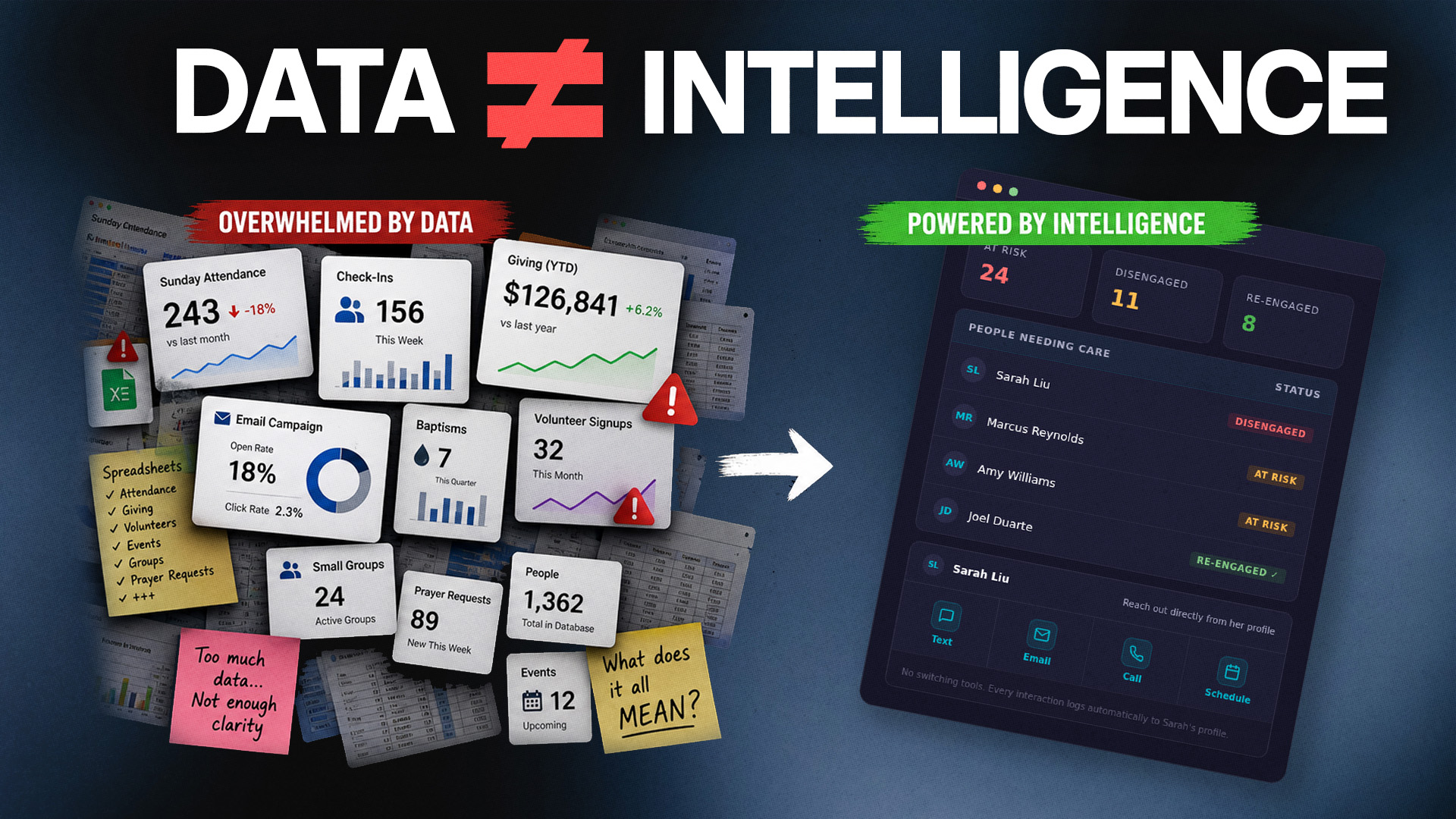
Right now, a real share of your staff's pastoral energy goes to detective work. Pulling reports. Cross-checking attendance against giving against group rosters. Assembling a picture of one person from six systems that never talk to each other. That is hours every week spent finding out who needs care instead of giving it.
The right systems handle the seeing so your people can handle the shepherding. They surface the person who is drifting before the drift becomes a departure, put that name in front of the right leader with enough context to make the outreach personal, and close the loop so you know whether the person came back.
Most systems stop at insight. They show you a chart and leave the hardest part to chance. The question that matters is not whether you can see who needs care. It is whether care is actually happening.
People do not need to be managed. They need to be known. Your job at scale is to build a church where being known does not depend on whether someone happened to cross your path this week.
Frequently Asked Questions
How do you provide pastoral care in a large church? Through a layered team rather than a single pastor. Care gets delivered by small group leaders, ministry leaders, campus staff, and care volunteers who each hold a defined group of people. What makes it work is not the org chart but the flow of information: every leader needs to know who they are responsible for and what to do when something changes.
How do you scale pastoral care as a church grows? By shifting from personal awareness to shared visibility. Noticing things yourself stops working somewhere around 400 to 500 people. Scaling care means assigning clear ownership for every person, agreeing on the signals that indicate drift, getting those signals to the responsible leader quickly, and tracking whether follow-up actually happened. Effort does not scale. Systems do.
What systems do large churches use to care for their members? Most run a church management system, a giving platform, an email tool, a groups tool, and an events tool. The challenge is that these rarely talk to each other, so no single person sees the whole picture of any individual. Growing churches increasingly connect those existing tools into one engagement view, so staff get a real-time picture of each person without pulling reports from six places.
How do you know your people in a church of thousands? You do not, personally, and that is the point. Being known is a team outcome, not a senior pastor outcome. Your responsibility shifts from knowing everyone yourself to ensuring every person is genuinely known by someone, and that when they start to disconnect, the right leader finds out in days rather than months.
The back door does not open all at once. It opens quietly.
You do not have to choose between growing your church and knowing your people. You do have to decide that visibility is worth building on purpose.
Nurture connects the tools your church already uses into one real-time picture of each person's engagement across attendance, giving, groups, serving, and communication. It surfaces who is drifting, puts that name in front of the right leader, and shows whether the follow-up actually happened.
Churches using Nurture saw 41.8% of at-risk attendees begin attending again, compared to 14.9% without it. 73.1% of lapsed volunteers began serving again, compared to 24.9%. 39.9% of lapsed donors began giving again, compared to 16.2%.
Those are not metrics. Those are names.
Book a Demo and make sure no one in your church is invisible.