If your team is asking what AI can do for your church, that's a sign you're paying attention to the right things. You're stewarding your time. You're trying to figure out where technology earns its place and where it gets in the way. You might be drafting an AI policy right now and wondering what to allow, what to flag, and what to leave out entirely.
This guide is for that moment.
It walks through three categories where AI is already showing up in ministry, what each kind of tool actually does well, where it hits a ceiling, and what needs to happen after the AI finishes its work.
No hype. No fear. Just an honest framework you can use to make decisions for your team.
We’ve split this guide into three primary categories:
- AI for Content and Communications
- AI for Giving and Financial Analysis
- AI for Attendance and Engagement Data
Let’s dive in!
Category 1 — AI for Content and Communications
This is where most churches start. Sermon research. Email drafts. Social media captions. Graphic generation. Newsletter copy. These tools save hours. They eliminate the blank-page problem. They scale the output of a communications team that's already stretched thin.
What they do well is real. They generate first drafts in seconds. They repurpose one sermon into ten pieces of content. They cut research time on a topic from hours to minutes. A one-person comms team can punch well above its weight.
What they can't do is also real, and it's bigger than most leaders realize.
AI hasn't sat with the family who lost a teenager last spring. It doesn't know that your community just walked through a layoff at the local plant. It doesn't carry the particular weight of your church's vocabulary or the metaphors that actually land in your room. AI mimics tone. It doesn't pastor people. And it has no way of discerning what your congregation needs to hear this week.
Use AI for content. Just don't outsource your voice to it.
Category 2 — AI for Giving and Financial Analysis
Most modern giving platforms now layer AI on top of donor data. Pattern recognition. Lapse prediction. Generosity campaign optimization. These tools surface financial trends faster than manual reporting ever could, and for a finance team running quarterly reports by hand, they're a meaningful step forward.
What they do well: identify which donors are slowing down before the quarterly numbers show it, forecast end-of-year giving with reasonable accuracy, and segment campaigns toward the right audiences.
What they can't do is the part that matters most pastorally. AI can show you that Marcus stopped giving in March. It can't tell you why. Was it a job change? Was it something his wife heard from the stage? Did his small group dissolve quietly six months ago and no one noticed?
AI flags the lapse. It never explains it.
And it certainly can't tell you whether a phone call from his small group leader would bring him back, or whether the right move is to leave him alone for a season and reach out at Easter.
The AI flags the pattern. The conversation is what re-engages the family — or doesn't.
Category 3 — AI for Attendance and Engagement Data
This is the fastest-moving category in church technology right now. AI can identify drop-off patterns, flag at-risk segments, and surface engagement signals that staff would never catch by hand.
What it does well: process attendance records across thousands of people in seconds, spot a pattern shift before staff would notice it manually, and identify clean segments — first-time guests who didn't return, kids whose check-ins dropped off, volunteers who haven't served in three weeks.
But here's where most AI engagement tools hit a hard ceiling. They live inside one platform. They see what's in front of them. They don't see across silos.
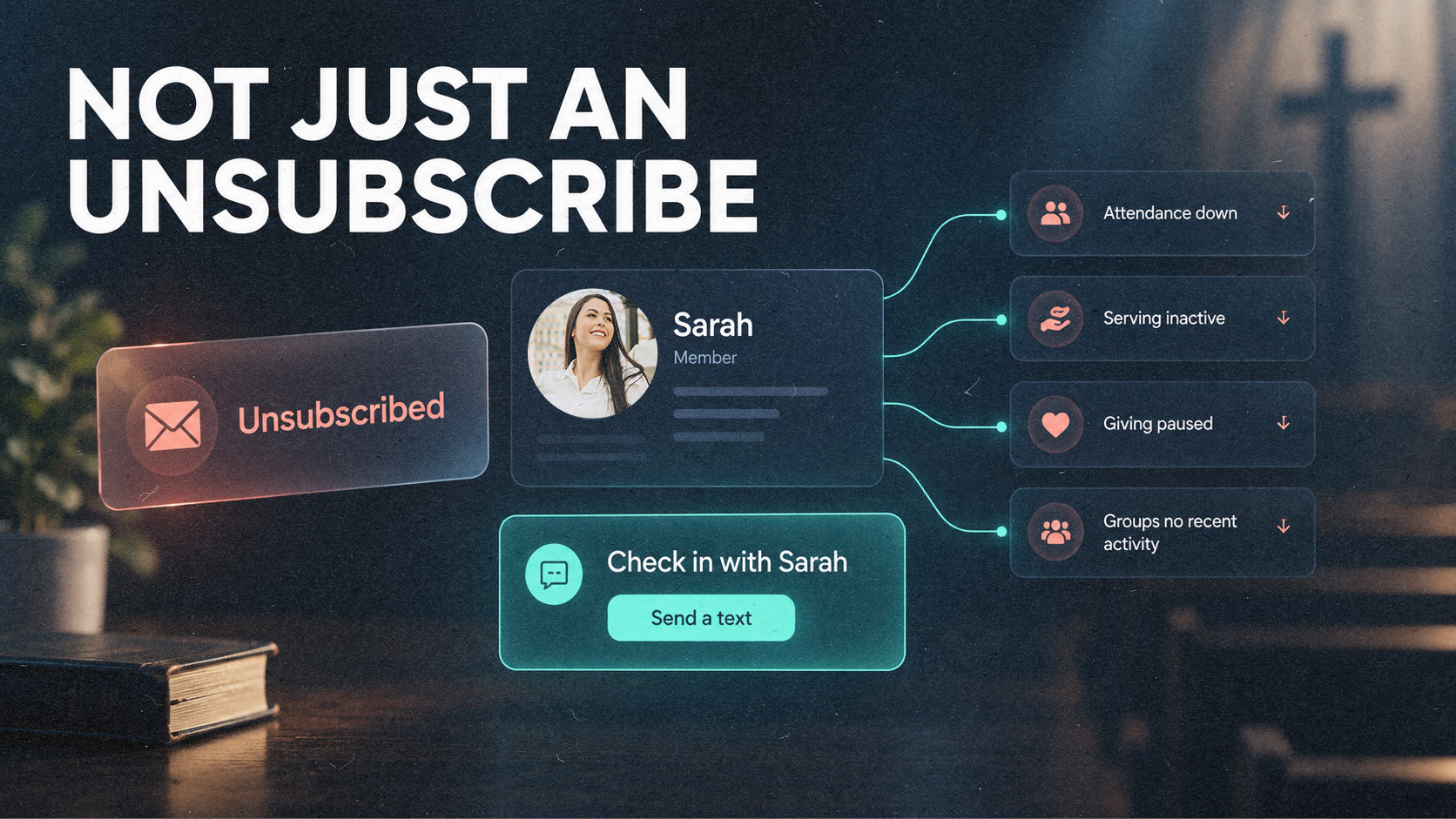
When attendance drops in one system, giving slows in another, and communication engagement falls in a third, no AI is connecting those three signals into a single story about a single family.
Each tool sees a fragment. No tool sees the person.
And even if it could, AI doesn't prompt a specific team member to follow up, log the touchpoint, and confirm the conversation happened. Insight is not action. Knowing someone is drifting is a different thing from making sure someone reaches out.
This is where the Shepherding Gap lives — and it's exactly where most AI tools stop.
The Throughline
In every category, AI produces insight. The question every pastor has to answer is the same:
What happens next?
Who actually acts on the insight? How quickly does that action happen? With what level of care? And how does leadership know the action took place?
That gap — between insight and pastoral action — is where families slip through the cracks. AI can help you do metrics better. It can't help you do ministry better. That part still belongs to people.
A Simple Framework for Evaluating Any AI Tool
Three questions. Run any AI tool through these before you sign up.
- Does it save time on tasks that don't require a human touch? Drafting copy, processing data, summarizing meeting notes — yes. Pastoring a hurting family — no.
- Does it free up staff for more pastoral moments? Or does it just produce more reports for staff to read?
- Does it make it easier or harder to know your people?
If the answer to that third question is "harder" — if the tool fragments your view, adds another login, or quietly replaces relationship with automation — that's a signal. Slow down.
A Note on AI Policy
If your church is drafting an AI policy for staff, the most important question to answer is not "what tools are allowed."
It's: where does the human relationship begin?
Draw that line first. Then build the policy around it.
For most churches, the line lives somewhere like this: AI can help us prepare. People do the pastoring. AI can draft. Pastors decide. AI can flag a pattern. A human reaches out.
When that line is clear, the policy almost writes itself. When the line is fuzzy, you'll spend the next two years cleaning up tools that quietly replaced the relationships they were meant to support.
Frequently Asked Questions
What AI tools are churches using right now?
Most churches are using AI in three places: content creation (ChatGPT, Claude, image generators for sermon graphics), email and copywriting (built into existing communication platforms), and engagement analytics (built into giving and ChMS platforms). The fastest-growing category is engagement analytics — tools that flag at-risk donors or attendance drop-offs inside whatever single platform a church already uses.
Should churches have an AI policy?
Yes — and it's simpler than you might think. The strongest AI policies don't try to list every approved tool. They draw a clear line between what AI is allowed to assist with and where human pastoral judgment is required. Once that line is clear, decisions about specific tools become much easier and a lot less anxious.
How do I know if an AI tool is right for my church?
Run it through three questions. Does it save time on tasks that don't need a human? Does it free your staff for more pastoral moments? Does it make it easier or harder to know your people? If the third answer is "harder," that's the signal to pass — no matter how impressive the demo looks.
What is the difference between AI engagement tools and a Relational Engagement System?
AI engagement tools produce insight inside a single platform. Your giving system flags a lapsed donor. Your ChMS flags an attendance drop. Each one tells you part of the story about a person.
A Relational Engagement System connects those signals across every system you use, gives you one unified picture of each person across attendance, giving, serving, groups, communication, and discipleship, surfaces the people who need care, assigns follow-up to a specific team member, and tracks whether the care actually happened.
AI stops at insight. A Relational Engagement System makes sure pastoral action follows.
If you want to see what it looks like to move from insight to pastoral action — to close the Shepherding Gap with one connected view of your people — book a demo with our team.