
Somewhere in your church's email platform, there's a notification nobody read.
Someone unsubscribed.
Maybe it was last Tuesday. Maybe it was a name you'd recognize from the lobby, the kids' wing, or the parking team. The platform logged it, dropped them from the list, and moved on. Nobody on staff thought twice.
In a marketing context, that's a list management event. A number ticks up by one. You check that your unsubscribe rate looks normal and get back to Sunday.
In a ministry context, it's a person pulling back.
Same click. Two completely different meanings. The question is which lens your team is reading it through.
The Communications Director's Blind Spot
Most church communications teams learned email from marketing tools, so they learned to read it like marketers. Open rates. Click rates. Unsubscribe rates. Best send times. Subject line tests.
None of that is wrong. It's how you get the right message in front of the right people.
But notice what those dashboards never ask: Who is this person? And what is this telling us about where they are right now?
Your email platform can report your unsubscribe rate to the decimal. It can't tell you that one of those unsubscribes came from a mom who served in kids ministry for six years and hasn't been back since spring.
That's not a flaw in the tool. It's just not what the tool was built to see.
What an Unsubscribe Might Actually Mean
Sometimes an unsubscribe is just inbox cleanup. Fair enough.
But sometimes it's something else:
- Someone who is drifting and doesn't want the weekly reminder of what they're missing.
- Someone who feels like the church isn't speaking to their life anymore.
- Someone in a hard season who needs quiet more than announcements.
- Someone who is one conversation away from leaving. Or one conversation away from coming back.
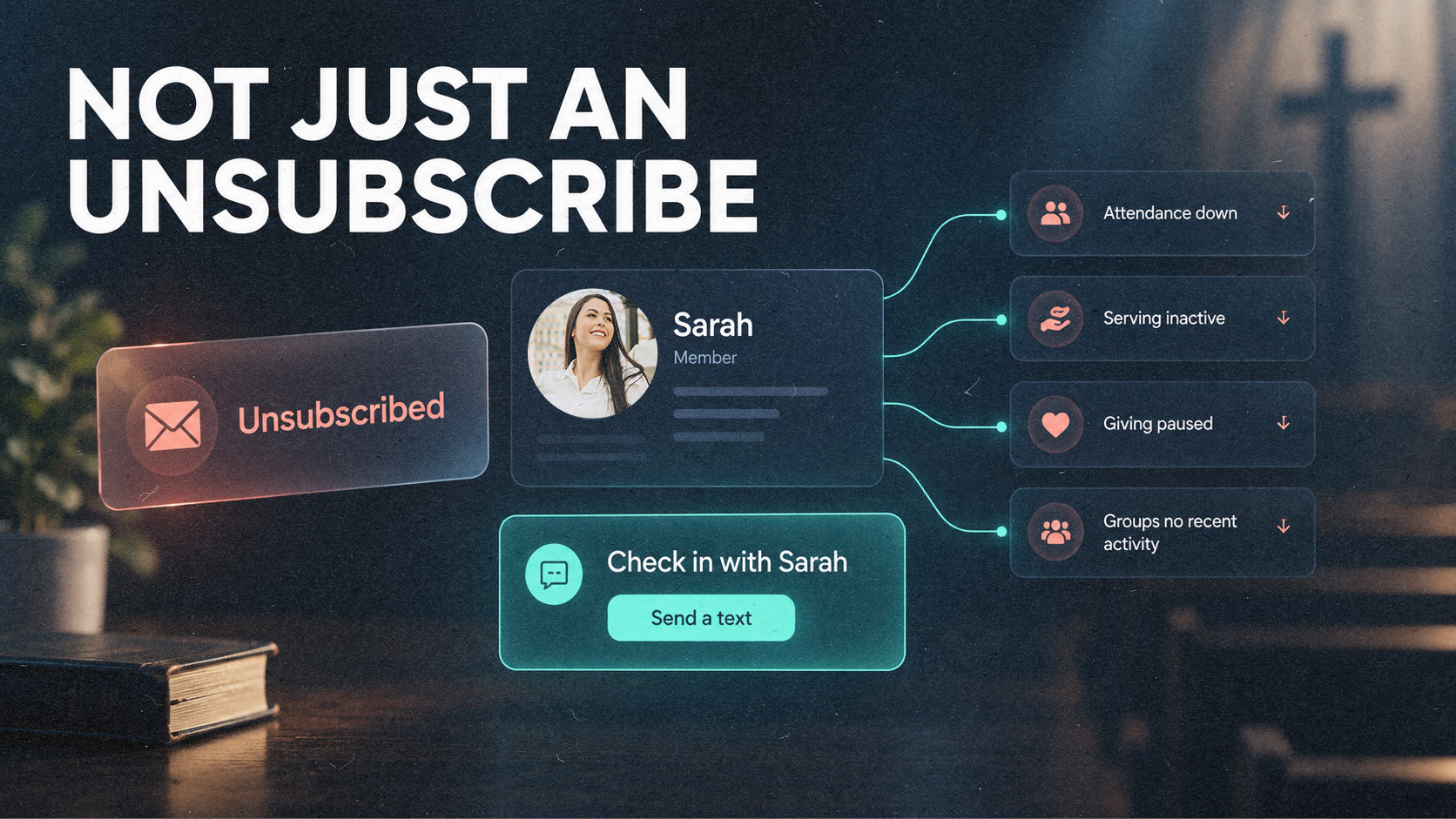
On its own, an unsubscribe is a whisper. But an unsubscribe from someone who also hasn't been in a service for five weeks and just stepped off the serving schedule? That's not inbox cleanup. That's someone walking toward the back door.
The Problem: The Pastor Never Sees It
Here's how it plays out in most churches.
The Communications Director sees the unsubscribe. The pastor never does.
Attendance lives in one system. Giving lives in another. Serving schedules live in a third. Email lives in a fourth. Each one holds a piece of the story, and each one belongs to a different person on your team.
So the connection never gets made. Comms sees a list shrink by one. The worship leader notices a gap on the schedule. Finance sees a recurring gift pause. Nobody puts it together.
The back door doesn't open all at once. It opens quietly.
By the time the drift is obvious enough to notice (usually a canceled gift or a run-in at the grocery store), the person has been gone for months. All the signs were there. They were just scattered across four systems and four inboxes.
Not because your team doesn't care. Because nobody could see the whole picture.
What It Looks Like When the Signal Gets Through
Now picture the same unsubscribe in a different church.
It doesn't sit alone in the email platform. It shows up in the same view as that person's attendance, giving, and serving. The team sees the pattern: fewer Sundays, a step back from the team, and now an opt-out from the newsletter.
A team member is assigned to follow up. They get a notification on their phone and send a text right from there:
"Hey, I've been thinking about you. We've missed you around here. How are you doing?"
No pitch. No guilt. Just someone noticing.
The conversation happens. Maybe it's a hard season. Maybe it's a hurt that never got addressed. Maybe they were just busy and it's a relief to be asked. Either way, they were seen before they were gone.
And it works. In an A/B test run from October 2024 to January 2025, 41.8% of at-risk attendees began attending again when their church had this kind of visibility and follow-up, compared to 14.9% without it.
That's the difference. Not better email. Better shepherding.
Change the Lens
You don't need to stop tracking open rates. Keep testing subject lines. Keep cleaning your list.
Just add one question to how your team reads the data: Who is this, and are they okay?
Every unsubscribe is a name. Most of the time it's nothing. Sometimes it's the last quiet signal before someone disappears. The churches that close the back door are the ones that treat that signal like it matters.
Frequently Asked Questions
What does it mean when a church member unsubscribes from email?
Sometimes it's simple inbox fatigue. Other times it signals drift, a difficult season, or a growing sense of disconnection from the church. On its own, an unsubscribe is hard to read. Seen alongside attendance, giving, and serving patterns, it becomes a much clearer signal of whether someone needs care.
How do churches use email engagement data for pastoral care?
By connecting it to everything else they know about a person. Opens, clicks, and unsubscribes mean far more when they sit next to attendance, serving, and giving trends. The key is routing that combined picture to a specific team member with a clear next step, so the insight turns into a conversation instead of a report.
What is the best email platform for churches?
The one your team will use consistently. Mailchimp, Constant Contact, and the messaging built into your church management software all work well for sending. The bigger question is whether the engagement data from that platform connects to the rest of your ministry picture. Nurture connects the tools you already use, so you don't have to switch platforms to see clearly.
How do you re-engage church members who have gone quiet on communications?
Change the channel and make it personal. Someone who opted out of the newsletter won't be won back by another email blast. A short text or call from someone they know, with no agenda beyond checking in, opens the door. Then follow up again in a week or two. Re-engagement rarely happens in one touch.
Somewhere in your church, someone just pulled back.
Nurture gives your team a real-time picture of each person's engagement, so you're the first to know when someone starts to drift, not the last.