CHURCH DATABASE VS. RELATIONAL ENGAGEMENT SYSTEM: WHAT'S THE DIFFERENCE?
If you're shopping for church database software, you're probably in a season of change. Maybe you've outgrown your current system. Maybe a migration is on the table. Maybe your staff has quietly stopped trusting the reports. Whatever brought you here, get clear on one distinction before you sign anything: a church database and a Relational Engagement System are two different tools that do two different jobs. Every church needs the first. Growing churches increasingly need the second. Here's how to tell them apart, and how to choose a database that sets you up for both.
WHAT A CHURCH DATABASE DOES
A church database, often called a church management system or ChMS, is the administrative backbone of your ministry. It does four things well:
- Stores contact information for members, guests, and families
- Records transactions like gifts, registrations, and check-ins
- Manages rosters for groups, teams, classes, and volunteer schedules
- Generates reports on what has already happened
This is essential infrastructure. You can't run a church without it, and platforms like Planning Center, Church Community Builder, and Rock RMS have earned their place by doing this work reliably for thousands of churches.
WHAT A CHURCH DATABASE DOESN'T DO
A database is built to record. It isn't built to notice. That's not a flaw. It's a scope. Here's what falls outside it:
- Detecting patterns across systems. Attendance lives in one tool, giving in another, groups in a third, email in a fourth. Each one sees its own slice.
- Surfacing who needs care today. Reports tell you what happened last month, if you know which report to run.
- Connecting siloed data into one picture of a whole person.
- Prompting a specific team member to take action.
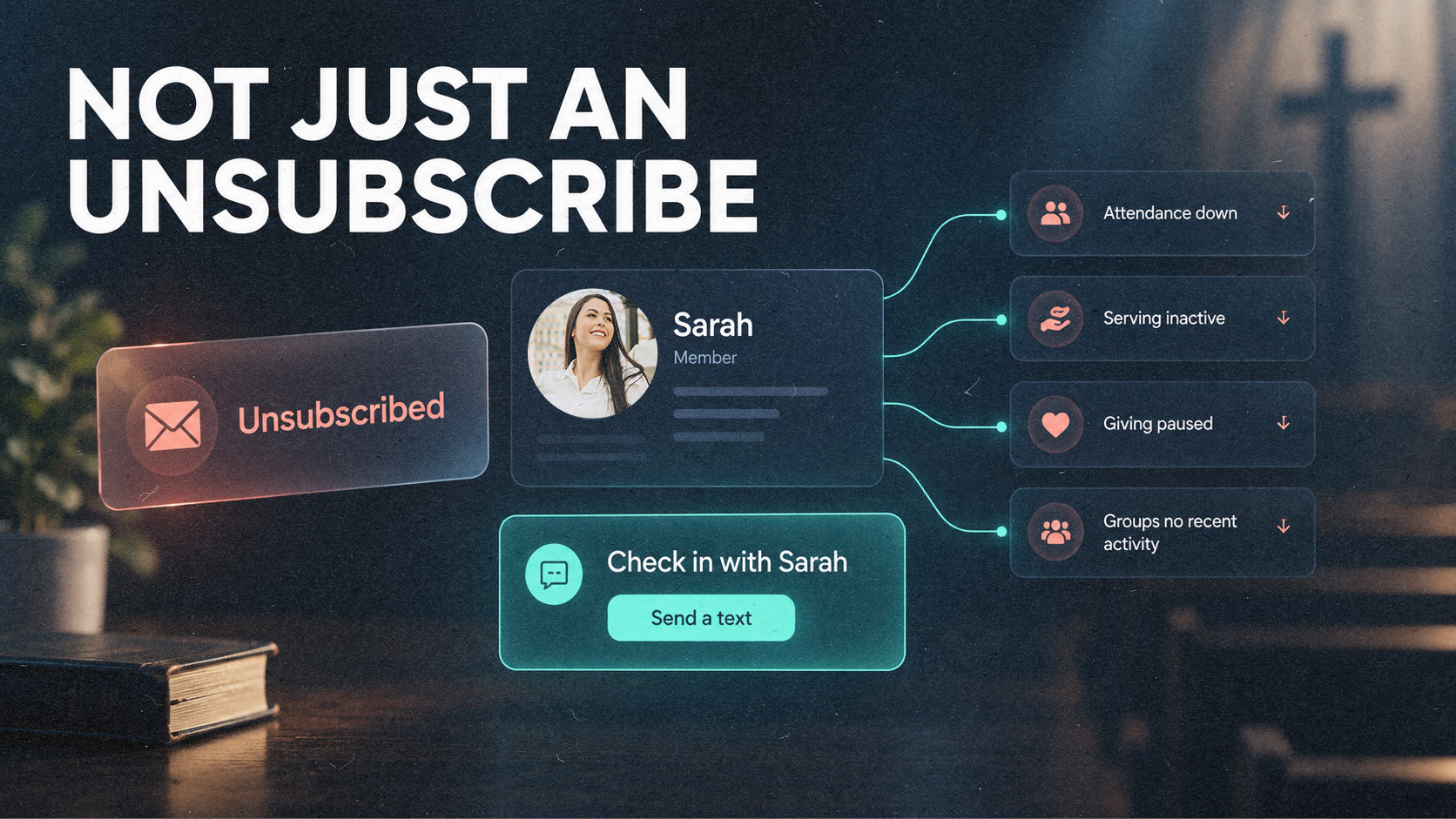
Picture a family that misses three Sundays. A few weeks later their recurring gift lapses. Then the dad stops opening church emails. Every one of those signals gets recorded somewhere. None of them triggers a phone call.
That space between when someone starts drifting and when someone on staff finally notices is the Shepherding Gap [link: /blog/what-is-the-shepherding-gap]. It isn't there because your team doesn't care. It's there because no one can see what's really going on.
ENTER THE RELATIONAL ENGAGEMENT SYSTEM
A Relational Engagement System is a separate category of church software. It doesn't replace your database. It's the intelligence layer that sits on top of it, connecting the tools you already use and turning scattered signals into pastoral care.
It does three jobs:
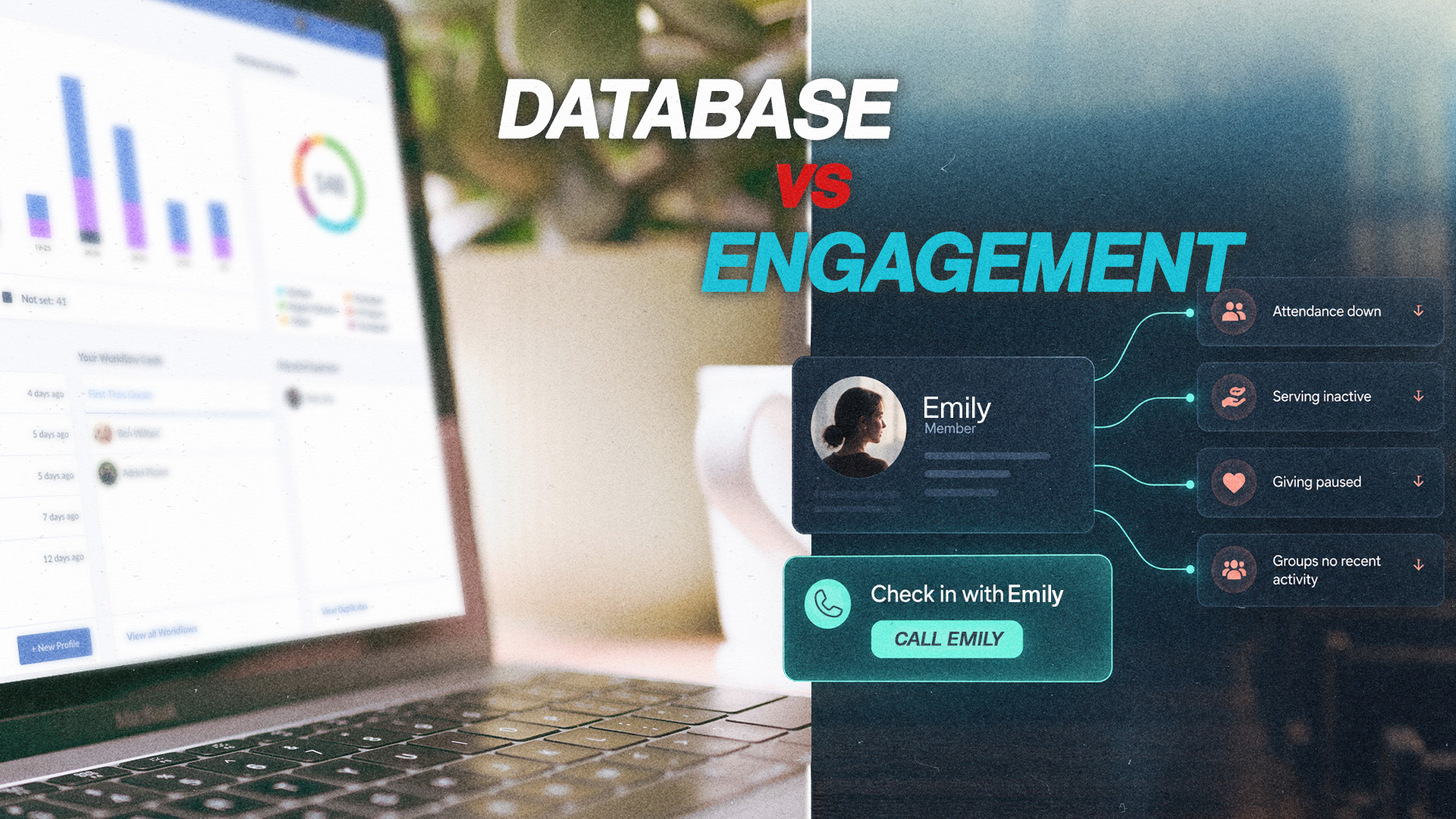
- Helps you see clearly. It pulls attendance, giving, groups, serving, communications, and discipleship into one real-time picture of each person.
- Helps you know who needs care. It surfaces early warning signs so your team sees drift while there's still time to respond.
- Helps you take action. Staff can assign follow-up to a specific team member, who gets a mobile notification and can text, email, log a conversation, or schedule a meeting without switching tools.
That last job is where the category earns its name. Most systems stop at insight. A Relational Engagement System also shows leaders who is following up, what's being said, and whether people are actually re-engaging. It tracks outcomes, not just activity.
THE PRACTICAL DIFFERENCE
The simplest way to hold the distinction is by the question each tool answers.
A church database answers: "Who is in our church, and what have they done?"
A Relational Engagement System answers: "Who needs care right now, and what should we do about it?"
One is a record of the past. The other is a prompt for today. Both questions matter, and you can't answer the second without good data from the first.
The difference shows up in outcomes. In a controlled A/B test of churches using Nurture, 41.8% of at-risk attendees began attending again, compared to 14.9% without it. 73.1% of lapsed volunteers began serving again, compared to 24.9%. And 39.9% of lapsed donors began giving again, compared to 16.2%. Those aren't metrics. They're names. People who came back because someone noticed in time.
IF YOU'RE EVALUATING OR MIGRATING YOUR CHURCH DATABASE
Choose your database for its administrative fit: your staff size, your ministry model, your workflows. But weigh one thing most buyers overlook. A database's integration capability decides whether you can ever close the shepherding gap. Ask every vendor these five questions:
- Do you have an open, documented API? This is the door every other tool walks through.
- How often does data sync? A weekly export means you see drift a month late.
- Is engagement captured at the person level? Attendance, giving, groups, and serving should be tied to individuals, not stored only as totals.
- Will our history come with us? Patterns depend on history. When you migrate, bring check-in and giving records over, not just the contact list.
- Does it connect to the rest of our stack? Giving, communications, and event tools should all be able to share data.
Get those answers right and you're free to choose the database that fits your team, knowing a Relational Engagement System can sit on top of it.
FREQUENTLY ASKED QUESTIONS
What is the best church database software?
It depends on your size, staffing, and ministry model. Planning Center, Church Community Builder, and Rock RMS each serve churches well. The best choice is the one your team will use consistently, that keeps clean person-level records, and that integrates openly with your other tools.
What is a Relational Engagement System?
A Relational Engagement System is church software that connects your existing tools into one real-time picture of each person, surfaces early signs of disengagement, and helps your team follow up and track whether people re-engage.
Does Nurture replace a church management system?
No. Nurture sits on top of the church management system you already use. Your database stays your system of record. Nurture connects it to your other tools and turns that information into timely pastoral care.
How is a Relational Engagement System different from a church database?
A church database records who is in your church and what they've done. A Relational Engagement System notices who is drifting, tells your team who needs care right now, and shows whether that care is actually happening.
SEE WHO NEEDS CARE THIS WEEK
Your database tells you who's in your church. Nurture tells you who needs you. If you're evaluating your tools, see what it looks like to be the first to know when someone is drifting, not the last.