Every growing church reaches a point where caring for people can't run on memory and a shared spreadsheet anymore. The information about your congregation is scattered. Someone asks how a family is doing, and the answer lives in four places, if it's written down at all. So you start looking for church CRM software: one place to organize contacts, track conversations, and make sure follow-up actually happens.
That's a real need, and it's worth solving well. It's also worth a closer look at what that kind of care actually requires.
Organizing people and knowing people are two different jobs
CRM stands for customer relationship management, and the model was built for sales. It assumes a pipeline: a contact enters, you log your touches, and you move them toward a close. It's good at what it was designed for. Organizing records. Tracking activity. Keeping a clean history.
That sounds close to what a church needs, and in part it is. But a congregation isn't a pipeline, and a person isn't a deal. You're not trying to move someone toward a transaction. You're trying to know them. To notice when a faithful family goes quiet, when a volunteer quietly steps back, when someone who used to be all-in starts to drift.
The difference comes down to one line. A CRM helps you organize people. Ministry requires you to know them.
The gap you can feel but might struggle to define
Say your church management system tracks attendance well. Your giving platform records every gift. Your communication tool logs every email. Each one is doing its job, and doing it well.
Here's the problem. Each one only holds a piece of the story.
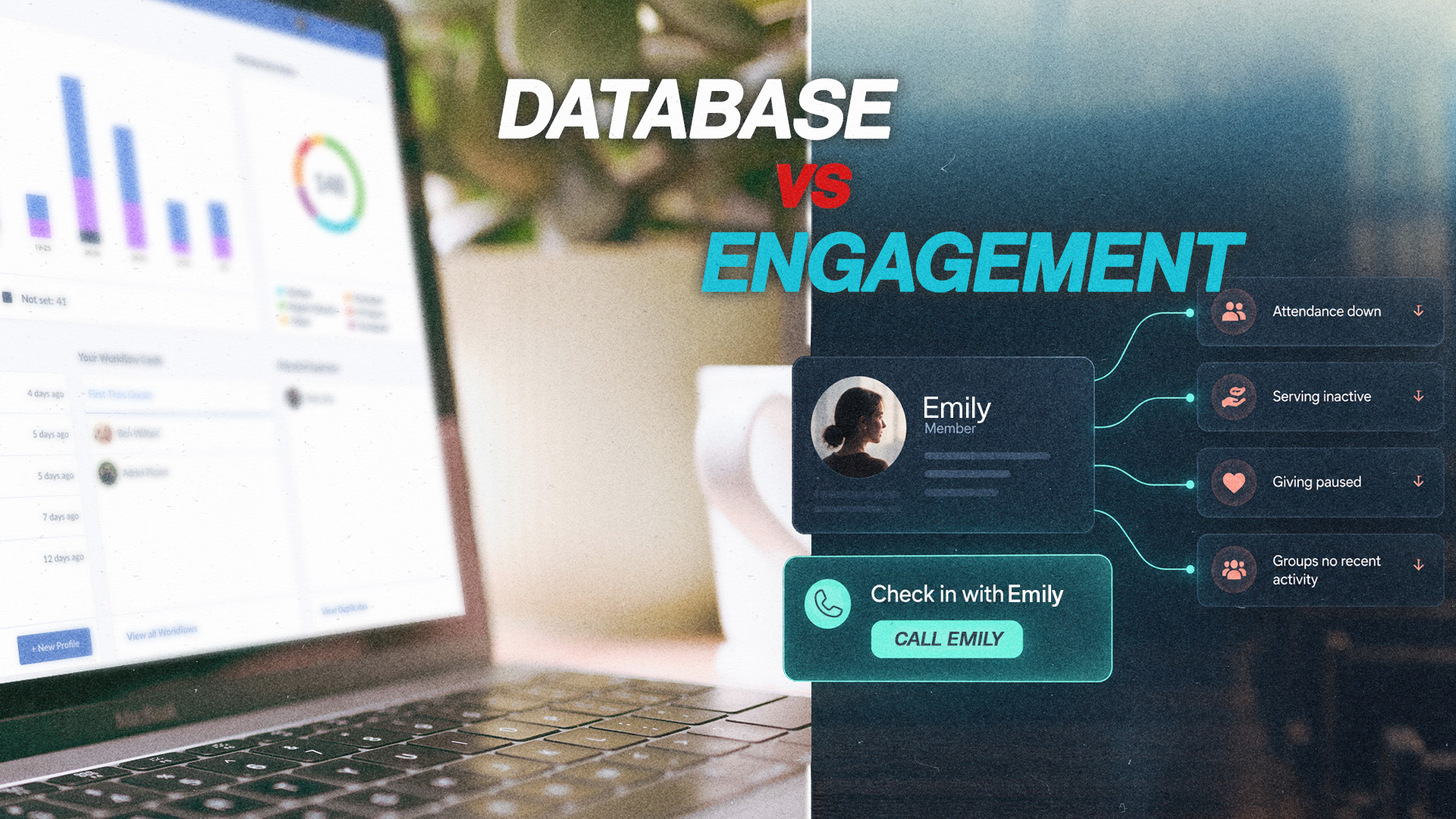
Attendance drops a little. Giving quietly stops. A volunteer cancels a couple of shifts. An email goes unopened. On their own, none of these is alarming. Together, they're telling you someone is slipping away. But no single system sees all of it, and a CRM, by design, stores what already happened. It doesn't surface what's happening right now.
So the signals are there. They're just scattered. And by the time the pattern becomes obvious enough for someone to notice, usually when the giving stops, that person has often been drifting for months.
This is the gap. Not a follow-up failure but a visibility failure. Your team didn't forget to reach out. They never saw there was someone to reach out to.
A Relational Engagement System closes the gap
A CRM organizes the data you already have. A Relational Engagement System does something a CRM can't. It connects the tools you already use and brings the signals that matter to the surface, so your team sees who's drifting before it's too late.
This is the part worth hearing clearly. It doesn't replace anything. Your Planning Center, your Pushpay, your email tool: keep all of it. They're storing the information beautifully, exactly as they were built to. What's been missing is a layer that sits on top of those tools, reads across them, and turns scattered data into a real-time picture of each person.
That's what Nurture does. It connects to the systems your church already runs and watches for the patterns no single tool can see, across attendance, giving, serving, groups, and communication. When someone starts to slip, it surfaces them and helps your team take action: a text, a call, a logged conversation, a follow-up someone actually owns.
We call the problem this solves the Shepherding Gap, the space between when someone starts drifting and when someone on your team actually notices. [Link: Shepherding Gap pillar page] If you want the full picture of how the gap forms and how to close it, start there.
The shift is simple, but it changes everything. Instead of a filing cabinet that stores history, you get a real-time view of who needs care this week. Instead of finding out months later, you become the first to know.
And it works. In an A/B test across Nurture church partners, 41.8% of at-risk attendees began attending again (compared to 14.9% without Nurture), 73.1% of lapsed volunteers began serving again (compared to 24.9%), and 39.9% of lapsed donors began giving again (compared to 16.2%).
Frequently asked questions
What is the difference between a church CRM and a Relational Engagement System?
A church CRM organizes contact information and tracks the interactions you log. It's a record of what has already happened. A Relational Engagement System connects the tools you already use and surfaces what's happening right now, flagging people whose engagement is changing across attendance, giving, serving, groups, and communication. A CRM stores history. A Relational Engagement System helps you see drift early enough to do something about it.
Does Nurture replace our church management system?
No. Nurture works alongside your ChMS, not in place of it. Your management system stores your data. Nurture sits on top of it and the rest of your tools, reading across them to show you a whole-person picture of each congregant. You keep every tool your team already knows.
Can Nurture integrate with our existing tools?
Yes. Nurture connects with the platforms churches already rely on, including giving tools like Pushpay, plus attendance, groups, serving, and communication systems, with 20+ integrations and growing. The whole point is to bring the insights already living in those tools to the surface and make them actionable, not to ask you to switch anything.
What is the best software for managing church member relationships?
The best fit depends on what you actually need. If you only need to store and organize contact data, a church CRM may be enough. But if your real concern is knowing who's drifting and making sure no one slips through the cracks as you grow, you need more than a database. You need a system that connects your existing tools and turns engagement signals into timely pastoral care. That's the category Nurture was built for.
See your people clearly
What most pastors are really after is a way to know their people. To be the first to notice when someone starts to drift, not the last.
Book a demo, and we'll show you how Nurture brings your existing tools together into one clear, real-time picture of your church, so no one stays invisible.