Planning Center is one of the best things that's ever happened to church operations. Most pastors I talk to use it for attendance, services, groups, check-ins, and volunteer scheduling — and they use it well. It's the digital backbone of how Sunday actually happens for thousands of churches.
This piece is not a critique of Planning Center. It's an honest observation about a limitation that has nothing to do with the quality of the tool — and everything to do with what it was built to do.
The Report That Doesn't Exist in PCO
Picture the query. The kind of report you'd ask for if you knew it was possible:
"Show me every person whose attendance has dropped, whose giving has changed, and whose serving has gone quiet — simultaneously, over the last 90 days."
That's the report that matters. That's the report that would have surfaced the warning signs in March — not in June, when the recurring gift finally cancelled. That's the report that would have flagged the volunteer who blocked out three weeks in a row right around the time her small group attendance went quiet.
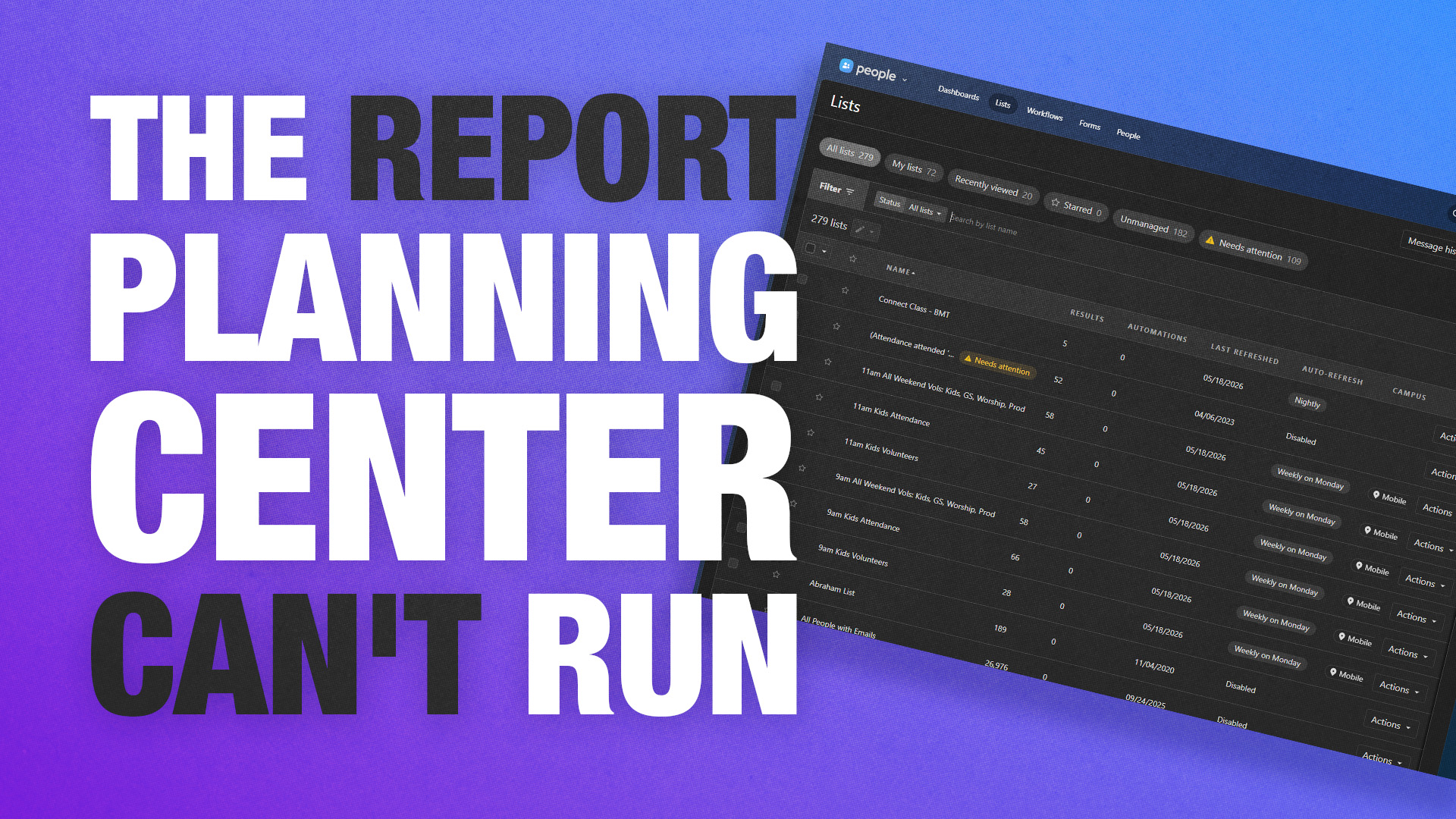
Try to run that report in Planning Center. You can't. Not because Planning Center is broken, but because it wasn't designed to answer that question.
Why That Report Doesn't Exist
Planning Center is a data storage and scheduling tool. It holds attendance check-ins. It tracks signups. It runs your service planning. It handles your volunteer roster beautifully.
What it doesn't do — because it was never built to — is connect attendance to giving in Pushpay, to serving patterns across ministries, to communication engagement in Mailchimp or Text In Church. Those are different platforms. Each one holds part of the story. None of them hold all of it.
This isn't a Planning Center failure. It's a category limitation. PCO sits in the Church Management System category, alongside Rock RMS, CCB, Realm, and a handful of others. Every tool in that category has the same constraint:
It tracks what it tracks. It doesn't read what other platforms track.
So the report that would actually help you shepherd well — the one that connects the dots across six different systems — has to live somewhere else.
The Shepherding Gap
At Nurture, we've named what happens in that space. We call it the Shepherding Gap — the space between when a person starts drifting and when someone on your team actually notices.
The gap isn't a follow-up problem. Most pastors I know are great at follow-up when they know someone needs it. The gap is a visibility problem. You can't follow up with someone you don't know is drifting. And no single system tells you that.
The attendance drop sits in Planning Center. The cancelled giving sits in Pushpay. The quiet small group weeks sit in another tool. The email unsubscribe sits in Mailchimp.
Four systems. Four pieces of one story. And no report anywhere that puts them together until it's too late.
Where Nurture Fits
Nurture is not a replacement for Planning Center. It sits on top of it.
We connect to the tools you already use — Planning Center, Pushpay, Rock RMS, CCB, your communication platforms — and we run that cross-system report automatically, every day. Then we surface the people who are showing change across multiple engagement areas at once. Not noise. Not low-signal absences. Patterns.
From there, your team can take action right inside Nurture:
- Send a text
- Send an email
- Log a conversation
- Schedule a meeting
And leadership can see whether the follow-up actually happened and whether the person re-engaged.
In an A/B test across our partner churches, 41.8% of at-risk attendees began attending again with Nurture, compared to 14.9% without. The difference wasn't better people. It was better visibility, earlier.
Planning Center + Nurture
The churches getting the most out of Nurture aren't switching from Planning Center (or whatever their existing ChMS is). They're keeping it. Planning Center keeps doing what it does best — services, scheduling, check-ins, groups. Nurture sits above it and answers the questions Planning Center wasn't built to answer.
Together, they give your team what neither tool can give on its own: clarity across the whole person.
Frequently Asked Questions
What can Planning Center track for church member engagement?
Planning Center tracks attendance through check-ins, volunteer scheduling and serving patterns inside its Services and Groups modules, group membership and meeting attendance, and event registrations through Registrations. It's strong at recording what happens inside the modules it owns. What it doesn't track natively is engagement across systems it doesn't own — giving (handled by Pushpay or similar), communication response (handled by Mailchimp, Text In Church, and others), or cross-platform pattern changes that often signal someone is starting to drift.
Does Planning Center integrate with giving platforms?
Planning Center has its own Giving module, and if your church uses it, that data lives inside the PCO ecosystem. If your church uses Pushpay, Tithely, Subsplash, or another giving platform, those donations live in those systems — and Planning Center doesn't pull that data in by default. Most growing churches end up running a giving platform separate from their ChMS, which is exactly why cross-platform visibility becomes a challenge as the church scales.
What is the difference between Planning Center and a Relational Engagement System?
Planning Center is a Church Management System (ChMS). It stores data, organizes scheduling, and supports operations. A Relational Engagement System like Nurture sits on top of your ChMS and other tools and turns the data into pastoral insight. A ChMS answers, "What happened?" A Relational Engagement System answers, "Who needs care right now, and what's the next step?" One is about operations. The other is about people.
Can Nurture work with Planning Center?
Yes. Planning Center is one of Nurture's core integrations. Nurture pulls attendance, group, and serving data from your Planning Center account, combines it with data from your giving and communication platforms, and surfaces engagement patterns for your team. Your Planning Center workflows don't change. Nurture just makes them visible in ways that weren't possible before.
Close the Shepherding Gap
If you've ever wished Planning Center could tell you who's quietly drifting before they're gone, you're not asking too much of the tool. You're asking the right question to the wrong system.
Nurture was built to answer that question.
Book a demo and we'll show you exactly how Nurture works alongside your Planning Center setup — and what becomes possible when no one in your church is invisible.